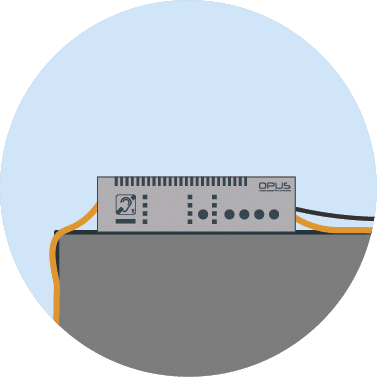
Loop amplifier – How it works ?
In 2024, 1.5 billion people worldwide suffer from hearing loss. Most of them use hearing aids, which increase the volume of nearby sounds. Unfortunately, these devices also amplify background noise, making it difficult for users to distinguish relevant information.
The solution is the hearing loop. The audio signal is converted by an Opus Technologies amplifier into electric pulses, then transmitted through a copper cable laid around the listening area. This generates a magnetic field that transmits the audio input directly to the user’s hearing aid.
For ONE-TO-ONE communication

The hearing aid must be activated in T mode to pick up this magnetic signal using an integrated copper telecoil (or T coil). The signal is then translated into audio and pure, clear sound is transmitted to the user’s ear.
Hearing loops (here, a DCL20) can be used in a wide range of installations, such as one-to-one communications at reception desks, ticket counters, money exchange and many more…
For LARGER listening area

Everywhere audio is essential, you can install a hearing loop system (here, a LD1.0) and make your facility more inclusive. Loop systems can be found in theatres, stadium, museum, supermarket, university, courtroom and many more.
You will find for example Opus loop drivers in Louvre museum, Orly airport or Cannes Festival Palace.